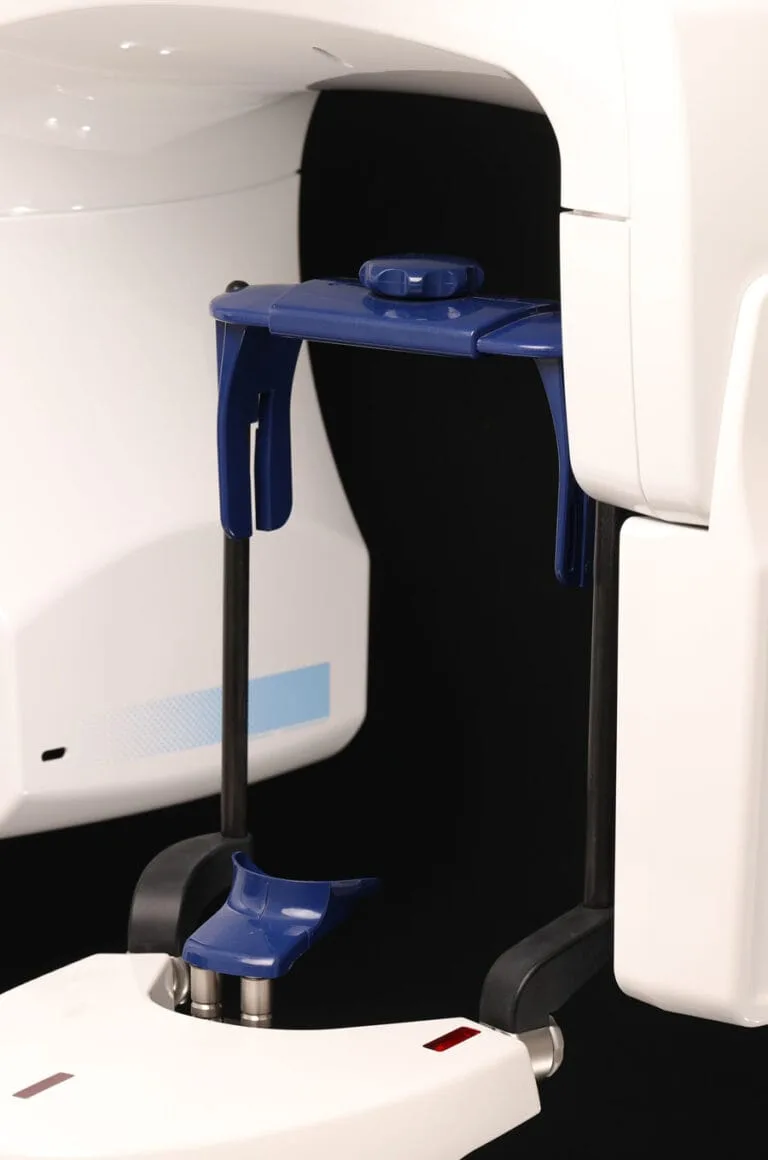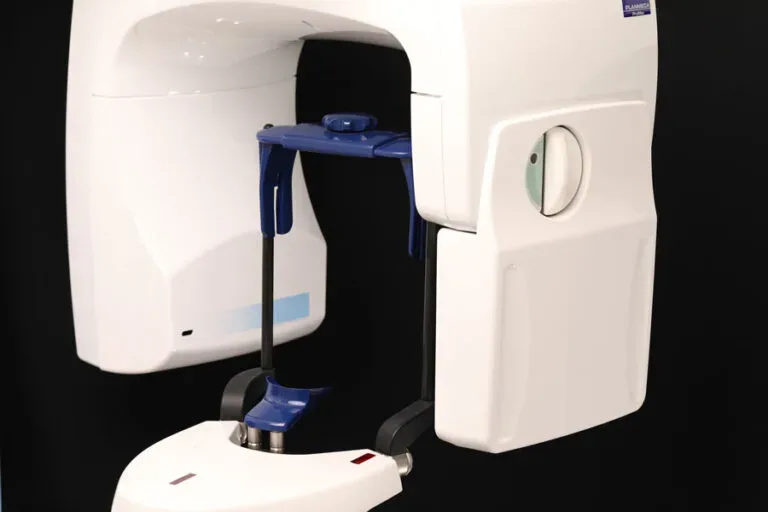
A panoramic X-ray (orthopantomogram, OPG) shows all the teeth, both jaws, the jaw joints and the lower part of the sinuses on a single image. The scan takes 10–20 seconds, you stand at the unit while it rotates around your head, and the image is on the screen immediately. The OPG is the first overview image I take for almost every new patient, because in one look it tells me where the problems are and which further examinations make sense. For a detailed image of an individual tooth see the dental X-ray page, and for a three-dimensional view of the bone see 3D dental imaging.
Who it is for
I take a panoramic X-ray when:
- you come for a first visit and I need an overview of the whole dentition, especially if you have not seen a dentist for a long time,
- we are checking the position of the wisdom teeth before removal,
- we are looking for hidden inflammation at the roots, cysts or root remnants left under a denture,
- we are assessing the general state of the bone in gum disease,
- I want a first orientation before planning implants, prosthetics or orthodontic treatment,
- we are assessing the development of the teeth in children and adolescents.
When an OPG is not enough or not the right choice:
- for a precise assessment of one tooth (small decay, a crack, a canal filling) the small intraoral image is more accurate, because the OPG has a lower resolution and often shows overlaps in the front of the mouth,
- for placing an implant the OPG alone is not enough: the image is two-dimensional and does not show the width of the bone or the exact distance to the nerve or the sinus; only a 3D CBCT scan shows that,
- during pregnancy we take an OPG only if it is necessary for treatment; non-urgent imaging is postponed.
How it goes
- A short conversation about your complaints and about what we want to learn from the image (5 minutes).
- Preparation: you take off glasses, earrings, necklaces, hair clips and removable dentures, because metal leaves shadows on the image. You put on a protective apron.
- Positioning: you step up to the unit, rest your chin on the support, bite on a small mouthpiece that aligns the teeth, and your forehead rests against the headrest. Correct positioning matters, so I check it with you.
- The scan: the arms of the unit rotate around your head in 10–20 seconds; during that time you stand still, do not swallow and do not move your tongue.
- Reading: the image is on the screen within seconds. We look at it together, I mark what I see and we agree whether an additional image is needed. If the OPG shows that we are planning an implant, we can take the 3D CBCT scan right away, at the same visit.
Altogether you are in the practice for about 15 minutes; in the great majority of cases the OPG is taken as part of the first visit.
Price
| Service | Price | What it includes |
|---|---|---|
| Panoramic X-ray (OPG) | 25–80 € | digital image of the whole dentition, reading and explanation |
| Dental X-ray (intraoral image) | 25–80 € | precise image of one to three teeth |
| 3D CBCT | 80 € | three-dimensional scan for implant planning |
| First visit with OPG | 50 € | examination, OPG, written treatment plan |
If you come for a first visit, you do not pay for the OPG separately: the first visit with an OPG costs 50 €, with a 3D CBCT 80 €. At the first visit you receive a written treatment plan with the final price, which is not binding for you. As a stand-alone service (for example at the request of another dentist) I charge the OPG according to the price list. Part of your dental costs can be claimed in Slovenia as a special tax relief; check the conditions with FURS.
Afterwards
There are no restrictions and no recovery after an OPG. The effective dose of a digital OPG is low, comparable to a few days of natural background radiation, which is considerably less than a conventional medical CT.
The OPG is not an examination to be repeated every year. With healthy teeth, every 3–5 years or when your condition changes is enough; for people with implants, dentures or gum disease more often, by agreement. I keep the image in your record so that at your next visit we can compare it with the previous one and see what has changed in the bone. If you recently had an OPG taken elsewhere, bring it along; if it is less than six months old and of sufficient quality, I do not repeat it.
Why at Koderman
- OPG and 3D CBCT in the same practice: from the overview image we can move on to precise planning at the same visit.
- I read the image myself and explain it to you, rather than just noting it in your record.
- The OPG is included in the price of the first visit (50 €), together with the written treatment plan.
- Appointment usually within 7–14 days, no waiting time.
- Explanation in Slovenian, German, English and Croatian.
Frequently asked questions
How much does a panoramic X-ray cost?
As a stand-alone service 25–80 €. At the first visit it is included in the price of the visit, which is 50 € (or 80 € if we take a 3D CBCT scan instead of the OPG).
Does an OPG hurt and how long does it take?
It does not hurt and you feel nothing. The scan itself takes 10–20 seconds, about five minutes with preparation. The only requirement is that you stand still while the unit rotates.
How much radiation do I get from an OPG?
Little; the dose of a digital OPG is comparable to a few days of natural background radiation and is many times lower than a medical CT of the head. Even so, we only take an image when it affects treatment.
Is an OPG enough for placing a dental implant?
For a first assessment yes, for the procedure itself no. The OPG is two-dimensional and does not show the width of the bone or the exact distance to the nerve or the sinus. Before placing an implant we therefore always take a 3D CBCT scan.
What is the difference between an OPG and a dental X-ray?
The OPG shows the whole dentition and both jaws on one image, but at a lower resolution. An intraoral X-ray shows one to three teeth very precisely. They often complement each other: the OPG for the overview, the small image for the detail.
Can I have an OPG during pregnancy?
Non-urgent imaging is postponed during pregnancy. If the image is necessary for treatment, we take it with a protective apron; the dose is low and directed far from the abdomen. Please tell me about a pregnancy before the scan.