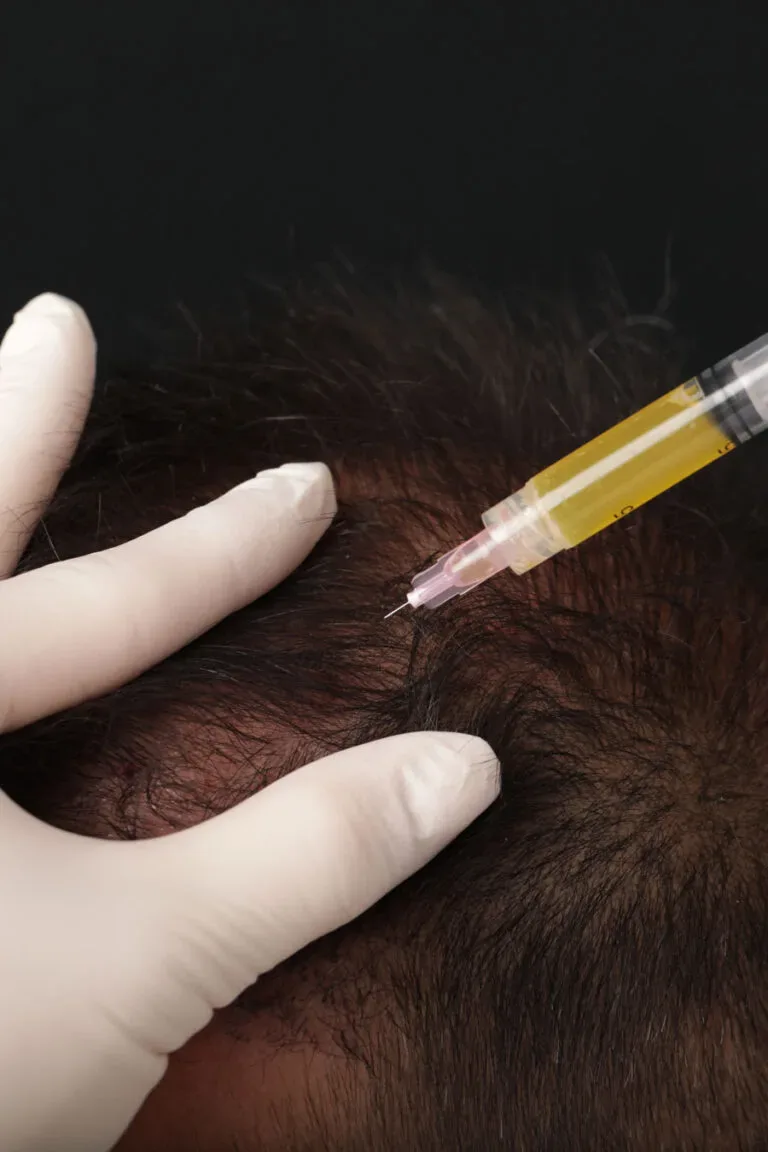
PRGF scalp treatment introduces plasma rich in growth factors from your own blood into the scalp with fine injections, in the areas where the hair is thinning. It works on hair follicles that are weakened but still alive: it prolongs the growth phase of the hair and thickens the hair shaft. It does not revive follicles that have already died, so it makes sense in the early stages of thinning, not in advanced baldness. The first effects appear after 3–6 months.
Who it is for
- Men with early to moderate thinning at the crown or temples (androgenetic alopecia) whose hair is thinner but whose scalp is not yet bare.
- Women with diffuse thinning along the parting, the most common form of hair loss in women.
- Increased shedding after childbirth, a serious illness, surgery or prolonged stress, as support so that growth settles faster.
- As a complement to medication such as minoxidil and finasteride, or after a hair transplant to help the grafts take.
When I do not perform the treatment or advise against it:
- Scarring alopecia (for example lichen planopilaris, frontal fibrosing alopecia): the follicles have been replaced by scar tissue and PRGF does not help; you need a dermatologist.
- Advanced baldness with smooth, shiny skin: there are no follicles left and the only effective route is a hair transplant. I tell you this plainly, even if it means I do not sell the treatment.
- In patchy hair loss (alopecia areata) treatment belongs primarily with a dermatologist; PRGF is at most a complement.
- During pregnancy and breastfeeding, with clotting disorders, anticoagulant therapy (assessed individually), active cancer or chemotherapy, and with inflammation or infection of the scalp.
- When the cause is unexplained: iron deficiency, thyroid disorders and some medications cause hair loss that PRGF will not fix. In that case I first recommend blood tests with your GP.
How it works
- Consultation and scalp examination. I assess the pattern and degree of thinning and ask about family history, medication and how the hair loss has progressed. We take photographs for comparison; without them the result cannot be judged honestly.
- Blood draw. We take 20–40 ml of blood from a vein in your arm, depending on the size of the area.
- Preparing the plasma. The blood is centrifuged, the platelet-rich fraction separated and activated immediately before use. Closed sterile system, no additives; about 15 minutes.
- Application. The scalp is disinfected and, if you wish, cooled or prepared with anaesthetic cream. Using a fine needle, the plasma is injected in shallow punctures about 1 cm apart across the whole thinning area. This takes 15–25 minutes; the whole visit about an hour. The hair does not need to be cut.
- Course. The initial course consists of 3–4 sessions 4 weeks apart. Then a maintenance session every 6 months, because without it the effect gradually fades.
- Assessing the result. We repeat the photographs after 3 and 6 months and assess whether to continue.
Price
| Service | Price | What it includes |
|---|---|---|
| PRGF scalp treatment | 190 € / session | consultation, blood draw, plasma preparation, application across the whole thinning area, photographic documentation |
| Initial course of 3–4 sessions | 3–4 × 190 € | sessions 4 weeks apart |
| Maintenance session | 190 € / session | every 6 months after the initial course |
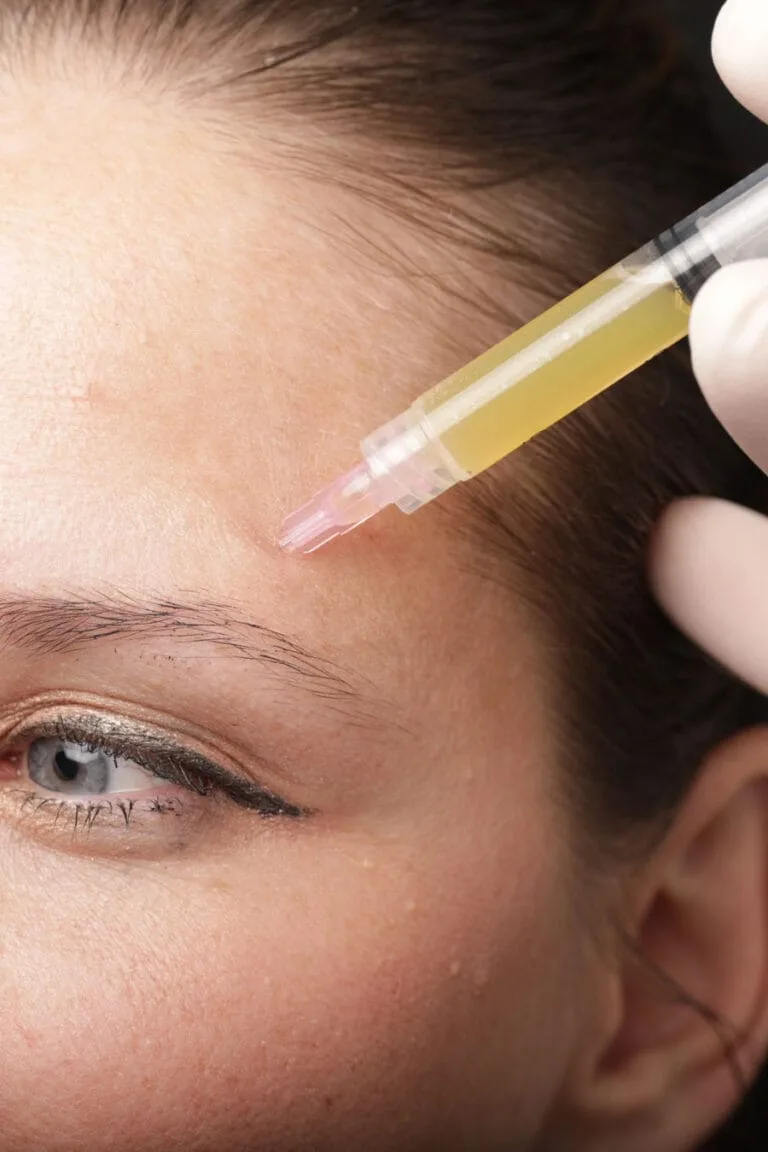
| PRGF facial treatment | 190 € / session | the same procedure for the skin of the face |
The price is per session and includes all materials; no X-ray is needed. If you also have a dental examination, we prepare a written treatment plan with the final price (50 € with a panoramic X-ray, 80 € with 3D CBCT). PRGF scalp treatment is a self-pay service not covered by public health insurance.
After the treatment
- The scalp is red, tight and tender to the touch for a few hours to two days; small bruises are rare. A headache on the first evening is not unusual and passes with paracetamol.
- You can wash your hair the next day with a mild shampoo. Avoid dyeing, sauna, swimming pools and intense exercise for 48 hours; for a week before and three days after the treatment do not take ibuprofen or similar anti-inflammatory drugs.
- The first sign of an effect is reduced shedding after 4–8 weeks. You notice new growth and denser hair after 3–6 months, with the greatest effect after the full course.
- Without maintenance the effect fades within 6–12 months, because PRGF does not remove the cause of hereditary hair loss.
- Realistically, expect moderate thickening and finer hairs becoming stronger, not the hair of your youth. Some patients do not respond to the treatment; we usually know this after 6 months.
Why Koderman
- PRGF is a daily procedure in our practice for oral surgery and bone grafting; the protocol is the same and well practised.
- The treatment is performed by a doctor, not a beauty salon; closed system and single-use kit.
- A realistic assessment up front: if your scalp is not suitable for PRGF, I tell you and refer you to a dermatologist or for a transplant.
- Photographic documentation at every session, so that the result is judged by pictures, not by feel.
- No waiting lists, an appointment usually within 7–14 days; we speak Slovenian, German, English and Croatian. Contact and directions.
Frequently asked questions
How many sessions do I need and what does it cost?
The initial course is 3–4 sessions at 190 € each, so 570–760 €. Then one maintenance session every 6 months at 190 €.
Does PRGF scalp treatment hurt?
The scalp is richly supplied with blood and sensitive, so the injections are felt more than on the face. With cooling or anaesthetic cream the treatment is uncomfortable but tolerable; most patients get through it without difficulty.
Does PRGF really work for hair loss?
Studies of platelet plasma in androgenetic alopecia show a moderate increase in hair density and thickness in the majority of those treated; the effect depends on the degree of thinning and the number of sessions. It is not a miracle cure: it works best early and does not work at all in advanced baldness.
PRGF or minoxidil and finasteride?
It is not either-or. The drugs suppress the hormonal cause of hair loss, PRGF stimulates the follicles; together they achieve more than either alone. Without the drugs, PRGF is a stand-alone option with a smaller effect.
When is PRGF not worthwhile?
In scarring alopecia, on smooth bald skin without follicles, and when hair loss is caused by an untreated illness or iron deficiency. In these cases I advise against the treatment.
Does PRGF replace a hair transplant?
No. A transplant moves follicles to the bald area, PRGF strengthens the existing ones. In advanced baldness a transplant is the only solution; PRGF is useful afterwards so that the grafts take better.