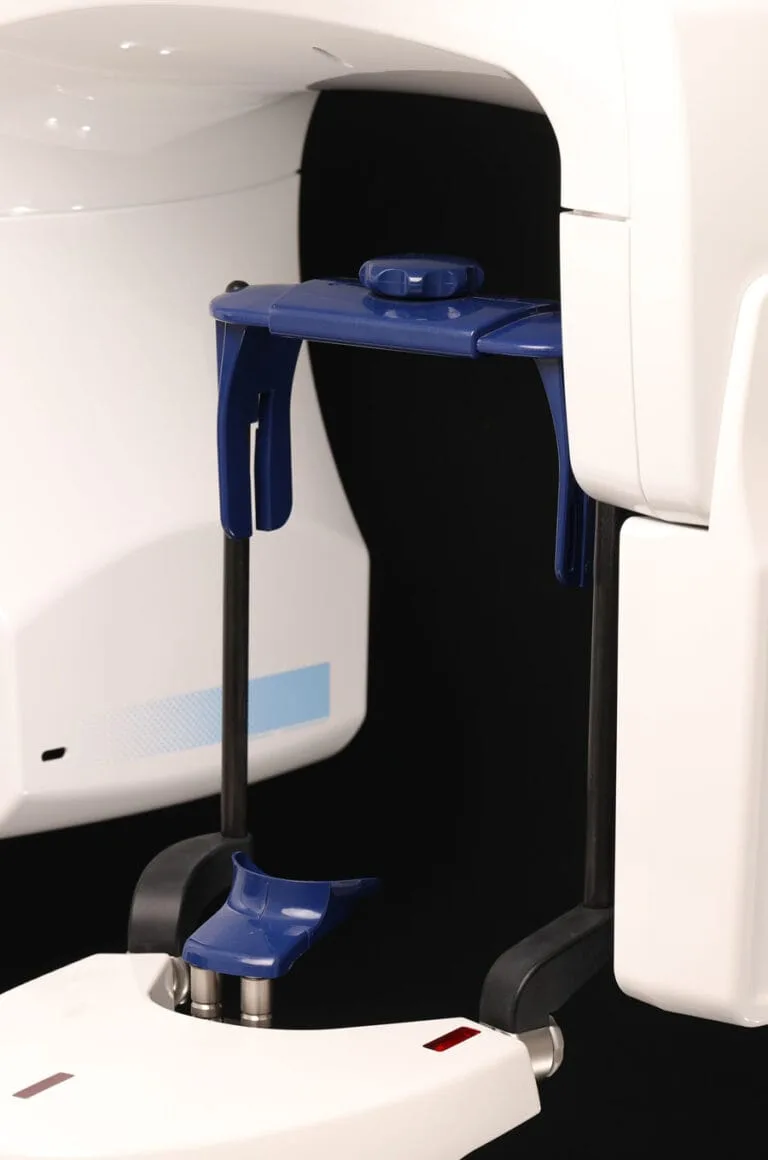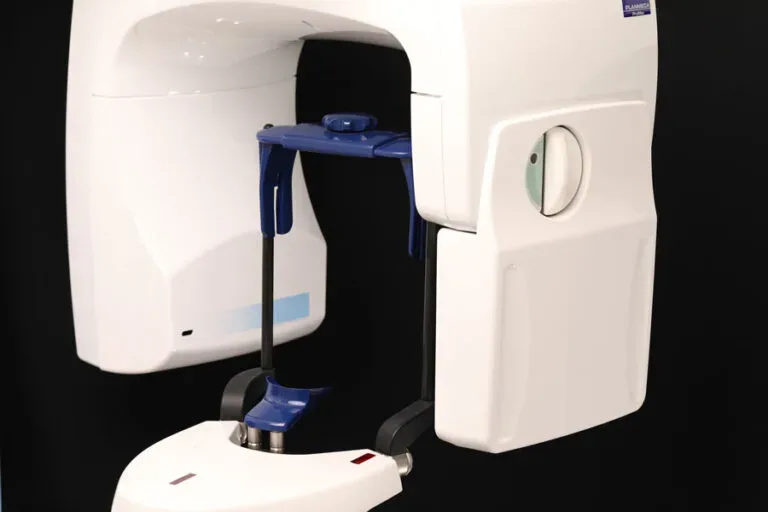
3D dental imaging (CBCT, cone beam computed tomography) is the only examination that shows the jawbone in all three dimensions: the height, width and density of the bone, the exact course of the lower jaw nerve and the floor of the sinus. The scan takes 20–40 seconds and the dose is considerably lower than that of a medical CT. In my practice I do not place a single implant without a CBCT scan; it is the examination on which safe planning rests. For the overview image of the whole jaw see the panoramic X-ray page, and for the small images of individual teeth see dental X-ray.
Who it is for
A CBCT scan is necessary or very useful when:
- we are planning dental implants, from a single implant to a whole jaw (All-on-4 / All-on-6); without a 3D scan the length, width and direction of the implant cannot be determined reliably,
- we are assessing whether bone grafting or a sinus lift is needed before placement, and to what extent,
- we are planning the removal of a lower wisdom tooth that lies right next to the nerve,
- during root canal treatment we are looking for an extra canal, a root fracture or the cause of pain that cannot be seen on a two-dimensional image,
- we are looking for unerupted teeth, cysts or changes in the bone whose extent we need to know before a procedure,
- we are assessing the jaw joint or the airway before orthodontic treatment.
When a CBCT scan is not needed:
- for a routine check-up, looking for decay or checking a filling, a panoramic X-ray or intraoral images with a lower dose are enough; CBCT is not a screening examination,
- during pregnancy we do not perform CBCT, except in rare emergencies,
- metal crowns and fillings leave artefacts on the image; I warn you about this in advance, because they can limit the assessment of a particular area.
How it goes
- Conversation and clinical examination (10 minutes). I decide which area we scan; often we scan only part of the jaw, which further reduces the dose.
- Preparation: you take off glasses, jewellery, hair clips, hearing aids and removable dentures, and put on a protective apron.
- The scan: you stand or sit at the unit, chin on the support, forehead against the rest. The unit rotates around your head in 20–40 seconds; during that time you keep completely still and do not swallow. You feel nothing.
- Reconstruction and reading (10–15 minutes): the software builds a three-dimensional model from the scan. We look at the cross-sections together, I measure the height and width of the bone at the site of each planned implant and mark the course of the nerve and the floor of the sinus.
- Plan: based on the scan I place the implants virtually and, where needed, make a surgical guide that transfers the planned position into the mouth. You receive the written treatment plan with the final price at the same visit.
Altogether it takes 30–45 minutes and in the great majority of cases is done as part of the first visit.
Price
| Service | Price | What it includes |
|---|---|---|
| 3D CBCT | 80 € | three-dimensional scan, measurements, reading and explanation, digital export |
| First visit with 3D CBCT | 80 € | examination, CBCT, written treatment plan |
| Panoramic X-ray (OPG) | 25–80 € | overview image of the whole jaw |
| Sweden & Martina dental implant | from 650 € | implant; crown on the implant 250–390 € |
If you come for a first visit and we decide on a CBCT scan, the visit costs 80 € and you do not pay for the scan separately; a first visit with a panoramic X-ray costs 50 €. At the visit you receive a written treatment plan with the final price, which is not binding for you. If you decide on implants, interest-free instalments through Leanpay for up to 24 months are also available for the total amount. Part of your dental costs can be claimed in Slovenia as a special tax relief; check the conditions with FURS.
Afterwards
There are no restrictions whatsoever after a CBCT scan. The effective dose of a dental CBCT depends on the size of the scanned field and is many times lower than that of a medical CT of the head; a rough comparison is a few days to a few weeks of natural background radiation. Because the dose is higher than for a panoramic X-ray, I take a CBCT only when the three-dimensional information really changes the plan.
I keep the scan in your record and on request you receive it on a data carrier in the standard DICOM format, which any dentist or surgeon can open. One CBCT scan is normally enough for the whole planning and the procedure; repeating it makes sense only if complications arise, after bone grafting before the implant is placed, or if more than about a year has passed since the scan.
Why at Koderman
- The CBCT scan is a mandatory part of planning for every implant, not an optional extra; the scan, the plan and the procedure are done by the same doctor.
- Digital planning of Sweden & Martina implants on the 3D model and, where needed, guided surgery with a surgical guide.
- Panoramic X-ray, CBCT, surgery and prosthetics under one roof; no referrals and no waiting for results.
- Appointment usually within 7–14 days.
- Explanation of the scan in Slovenian, German, English and Croatian; for patients from abroad I prepare a free remote cost estimate before they travel, if they send an existing scan.
Frequently asked questions
How much does 3D dental imaging cost?
80 €. If the scan is taken at the first visit, that is also the price of the whole visit, including the written treatment plan.
Is a CBCT scan necessary before placing an implant?
In my practice, yes. A panoramic X-ray does not show the width of the bone or the exact distance to the nerve or the sinus; without that information an implant cannot be placed safely.
How much radiation do I get from a CBCT scan?
It depends on the size of the field, but many times less than a medical CT of the head and roughly the equivalent of a few days to a few weeks of natural radiation. We reduce the dose further by scanning only the area we need.
Does the scan hurt and how long does it take?
It does not hurt and you feel nothing. The scan itself takes 20–40 seconds; with preparation and reading, allow 30–45 minutes.
Can I bring a CBCT scan taken elsewhere?
Yes. If the scan is in DICOM format, less than about a year old and covers the area we are planning, I use it and do not repeat the scan.
What is the difference between CBCT and a medical CT?
Dental CBCT uses a cone-shaped beam and scans only the head or part of the jaw, so the dose is considerably lower and the resolution in bone is better for our purposes. A medical CT is designed for soft tissue and is normally not needed in dentistry.