For most patients the right answer is titanium: it has more than 50 years of clinical data, 95–98 % survival at ten years and the widest range of prosthetic options. Ceramic (zirconia) implants make sense in a narrower set of cases – front teeth with thin gums and the rare patient with a proven metal sensitivity – and typically cost 300–500 € more per implant. Below I explain how the two materials differ, where the limits of each lie and how we decide at our clinic.
Two materials, one job
A dental implant is an artificial root placed in the jawbone to carry a crown, a bridge or a fixed denture. The job is the same for both materials; the difference is what the root is made of and how it behaves in bone, in the gum and under chewing load.
The titanium implant
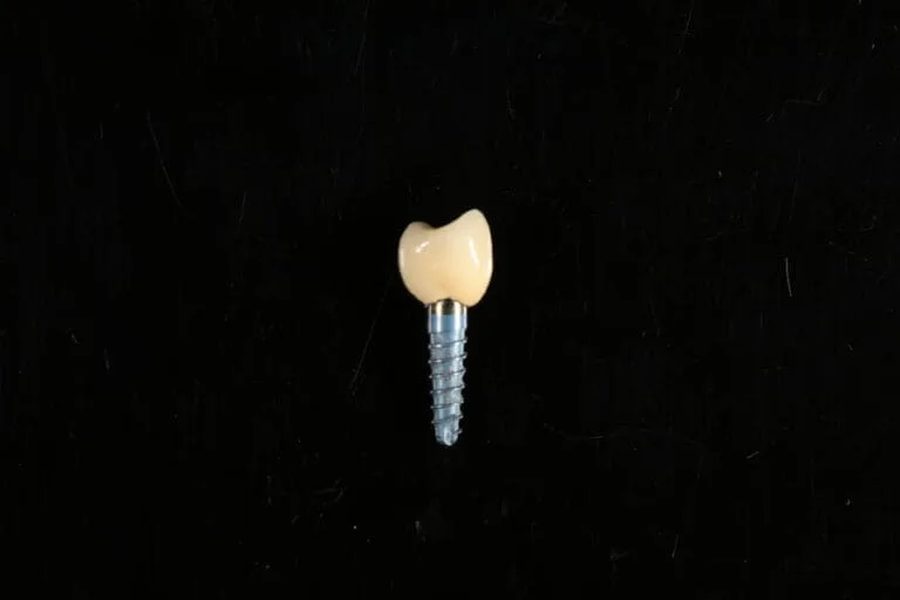
Titanium has been the standard in implantology since the 1970s. Bone bonds to it reliably (osseointegration), the material is tough and it withstands the bending forces that arise during chewing. Modern titanium implants are two-piece: the implant goes into the bone and an abutment that carries the crown is screwed onto it later. That lets me adjust the angle and height of the abutment to the neighbouring teeth even when the bone did not allow an ideal direction of placement.
The drawback is colour. Titanium is grey and, with very thin gums, it can show faintly through at the crown margin. Nobody notices this on a molar; on an upper central incisor with thin gums, they might.
The ceramic (zirconia) implant
Ceramic implants are made of zirconium oxide – the same white, very hard ceramic that modern crowns are made of. They contain no metal, they are white, the gum adapts to them well and plaque adheres somewhat less. With no metal there are no galvanic effects between different metals in the mouth, which some patients perceive as a metallic taste.
There are three drawbacks. There is less long-term data: the longest serious studies cover about 15 years, not 50. Most ceramic implants are one-piece or offer a limited choice of abutments, so correcting the angle is harder. And zirconia is hard but brittle: under heavy grinding it can fracture, whereas titanium bends.
Titanium and ceramic implants compared
| Criterion | Titanium implant | Ceramic (zirconia) implant |
|---|---|---|
| Material | Titanium alloy, metal | Zirconium oxide, metal-free ceramic |
| Colour and esthetics | Grey; can show through thin gums | White; esthetically better with thin gums |
| Long-term data | More than 50 years, 95–98 % survival at 10 years | About 15 years; comparable short term, less known long term |
| Design | Two-piece (implant + abutment) | Mostly one-piece or limited choice of abutments |
| Angle correction | Simple with an angled abutment | Harder, sometimes not possible |
| Teeth grinding (bruxism) | Tolerates it well, the material yields | Brittle, higher risk of fracture |
| Allergy to the material | Extremely rare | No known allergies |
| Healing | 3–6 months | 3–6 months, one-piece designs often need longer protection from load |
| Indications | All positions, All-on-4 and All-on-6 | Single front teeth, proven metal sensitivity |
| Implant price at our clinic | From 650 € | Typically 300–500 € more than titanium |
Esthetics: the crown often matters more than the implant
What patients see in the mirror is the crown and the gum around it, not the implant. The implant sits in the bone, under the gum. So the only question is whether grey titanium will show through the gum anywhere.
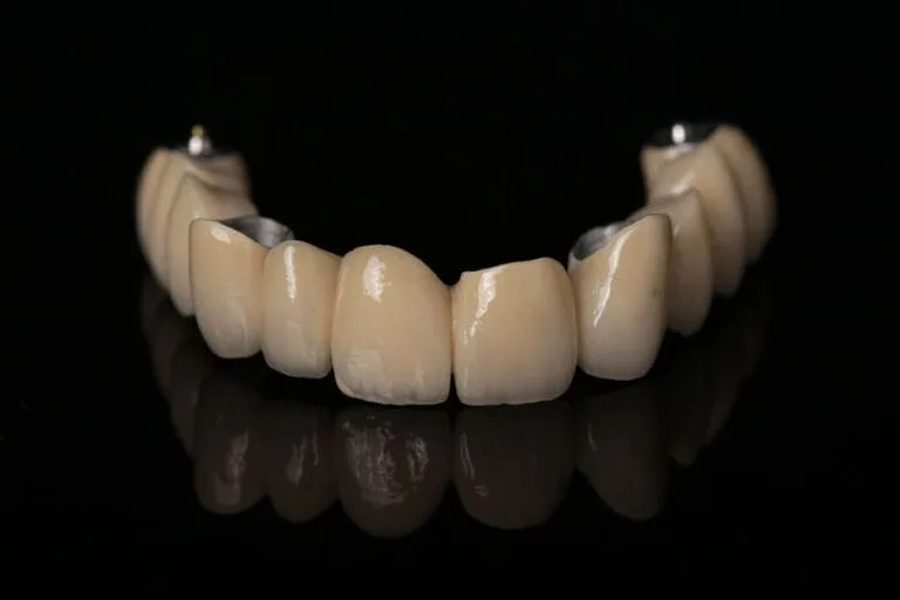
With thick gums (the so-called thick biotype) it will not. With thin gums on the front teeth it can, and there are two solutions: a ceramic implant, or a titanium implant with a zirconia abutment and a zirconia crown. The second option is the most common esthetic solution in practice and costs less. At Koderman we make a ceramic crown for 250–390 €, whichever implant sits beneath it.
If appearance worries you, we will talk about the gum at the consultation, not only about the implant. I measure the thickness of the gum and bone, and in borderline cases we can also thicken the gum around the implant.
Longevity: what we know and what we do not yet
We know a lot about titanium. Ten-year implant survival in large studies is 95–98 %, and the oldest documented implants have been working for more than 40 years. When I tell a patient the implant will probably outlive them, I have grounds for it.
With zirconia, the results of the first 5–10 years are encouraging and in some studies comparable to titanium. What we do not know is how they behave after 20 or 30 years, simply because they have not been in mouths that long. Early generations of ceramic implants had more fractures; today's materials are better, but that legacy explains why most implantologists are cautious.
To be clear: that is not an argument against ceramic, it is a reason to choose it deliberately.
Teeth grinding and chewing load
If you grind or clench at night, the forces on an implant are several times higher than in normal chewing. Titanium takes those forces because it bends slightly; zirconia does not bend, it cracks under overload. A fractured implant in the bone means surgical removal and re-placement after healing.
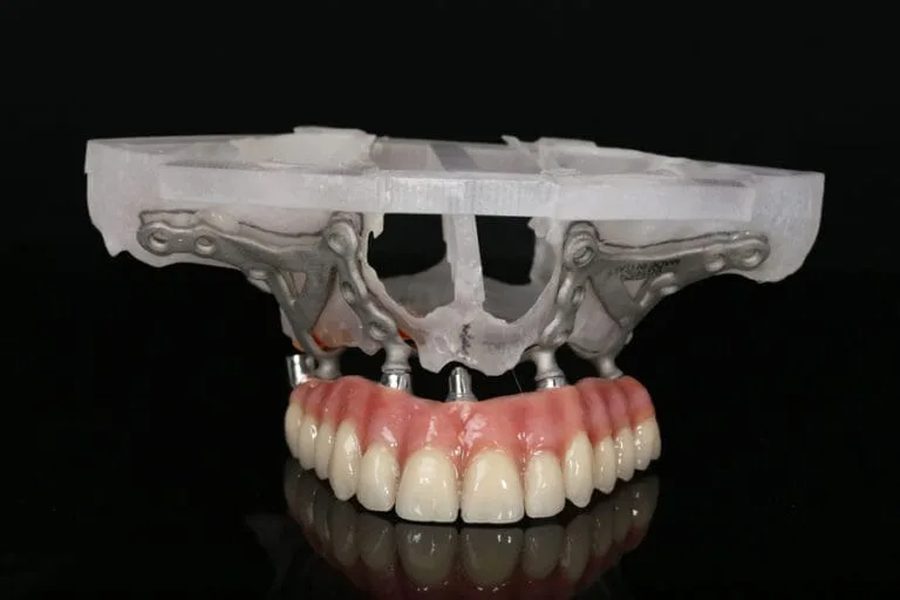
That is why, with pronounced bruxism, on molars and with fixed bridges on four or six implants (All-on-4 and All-on-6), I recommend titanium. In such reconstructions angled abutments are also a necessary part of the plan, which one-piece ceramic implants do not allow.
“Titanium allergy”: what I see in practice
Every month someone asks me whether they are allergic to titanium. In my practice I have not yet seen a confirmed case. True titanium hypersensitivity is described in the literature in fewer than one per cent of people, and even those figures are uncertain because the tests for it are not standardised.
What patients describe as an “allergy” – redness, swollen gum, a burning feeling, a metallic taste – is almost always something else: inflammation around the implant caused by plaque, a remnant of cement under the gum, nickel sensitivity from old metal crowns, or overload. Before we change the material, we look for the real cause.
If you have a proven metal allergy confirmed by an allergist, or you decline metal in your mouth for other reasons, a ceramic implant is a justified choice. I will not talk you out of it.
Cost: how much more a ceramic implant costs
At Koderman a Sweden & Martina titanium implant costs from 650 € and the ceramic crown on it 250–390 €. A ceramic implant typically costs 300–500 € more per implant; you get the exact quote at the consultation, because it depends on the chosen system and abutment. Everything else is the same:
- first visit 50 € with a panoramic X-ray or 80 € with a 3D CBCT scan, and the treatment plan is non-binding;
- bone graft or sinus lift, if needed, 250–800 €;
- interest-free instalments through Leanpay for up to 24 months;
- the Slovenian health insurance ZZZS does not cover implants, whatever the material (more in the article Does ZZZS cover dental implants).
Part of the treatment cost can, under specific conditions, be claimed in Slovenia as a special tax relief; because the rules change, check the current conditions with the tax authority FURS or your accountant and keep the invoices.
A more detailed price overview is in the article How much do dental implants cost in Ptuj.
Which implant I recommend to whom
The decision is always individual, but some patterns repeat.
- Front tooth, thin gums, high smile line: consider a ceramic implant or a titanium implant with a zirconia abutment. We decide after measuring the gum thickness.
- Molars and premolars: titanium. The loads are high and esthetics is not an issue.
- All-on-4, All-on-6, several splinted implants: titanium, because we need angled abutments and a tough material.
- Proven metal sensitivity: ceramic.
- Teeth grinding: titanium and a night guard, whatever the position.
- Little bone: titanium, because narrower and shorter models and tilted placement are available; with severe bone loss, subperiosteal implants are the alternative, and they are titanium.
How we decide at Koderman
Our standard is the titanium implant of the Italian manufacturer Sweden & Martina, with which we have many years of experience and which carries a lifetime manufacturer's warranty on the implant body. We place ceramic implants at the patient's request, through the same manufacturer's system, when the conditions for it are met.
We make the decision at a consultation with a 3D CBCT scan. On it I measure the width and height of the bone and the direction in which I can place the implant; if a tilt is needed, a one-piece ceramic implant is out. I look at the gum, the teeth in the opposing jaw and signs of grinding. Only then do I tell you what I would choose for myself.
The warranty is the same for both materials: if the implant does not integrate with the bone in the first six months, I place a new one free of charge. Details are in the article Warranty on dental implants.
Frequently asked questions
Are ceramic implants stronger than titanium ones?
No. Zirconia is harder but more brittle. Titanium withstands bending, zirconia cracks under overload. For chewing load, titanium is the more reliable material.
Do ceramic implants last as long?
Probably, but we cannot prove it yet. For titanium we have data spanning more than 50 years, for modern zirconia about 15. The results of the first ten years are comparable.
Can All-on-4 be made with ceramic implants?
Technically yes, but I advise against it. A fixed bridge on four implants needs angled abutments and a material that withstands large forces. At our clinic we build All-on-4 and All-on-6 on titanium implants.
For looks, does the crown or the implant matter more?
As a rule, the crown and the gum. A zirconia crown on a titanium implant is the most common esthetic solution; a ceramic implant makes sense when the gum is so thin that titanium would show through.
I have a titanium implant and I am worried about an allergy. Should I have it replaced?
Not without a clear reason. If the implant does not hurt, is not loose and the gum around it is not inflamed, the material is most likely not causing any problem. First we do an examination and, if needed, a 3D scan; I do not recommend replacing a healthy implant on suspicion alone.
Does placing a ceramic implant hurt more than a titanium one?
No, the procedure is the same and is done under local anaesthesia. I write more about this in the article Do implant procedures hurt.
Book a consultation
If you are deciding between titanium and ceramic, the most useful step is a consultation with a 3D scan (80 €), at which I assess the bone, the gum and the load and prepare a non-binding plan with prices for both options. An appointment is usually available within 7–14 days, and we speak Slovenian, German, English and Croatian.
- Phone: +386 51 452 627
- E-mail: info@koderman.eu
- Address: Hreničeva ulica 3, 2250 Ptuj
- Opening hours: Mon 9–16, Tue–Fri 9–15
Author: Dr. Antonio Koderman, DMD & MSc in Implantology — implantology specialist, Koderman Implant Centre, Ptuj.